



Introduction
Medicolegal entomology is an area of forensic entomology that concerns the role of insect evidence in criminal investigations [1,2]. In routine pathological examination, it may be difficult to identify remains and accurately establish the time-since-death after more than 3 days post-mortality. In this regard, however, entomological approaches have been developed as complementary or substitute tools in forensic investigations, which are based on the observation that the insects that feed on carrion constitute a distinct faunal succession that corresponds to the progressive stages of decomposition [3].
Carrion beetles (Coleoptera, Silphidae) play essential roles in biological decomposition, and although primarily carrion feeders (necrophagous species), they may also act as predators by consuming other carrion inhabitants [4-7]. As such, the postmortem colonization of these beetles can provide useful information regarding the time-since-death [8-10]. For example, the findings of recent studies have indicated that Thanatophilus micans Fabricius can locate a corpse within 24 hours, and that their larvae are observed soon after death at an early stage of decomposition [11,12]. This implies that certain species could be pioneers in exploring corpses and thereby provide potentially useful clues for forensic investigation, similar to the behavior of blowflies that are deemed important indicators in forensic entomology [11,12].
The coleopteran family Silphidae consists of a relative small group of beetles, comprising 183 known species in 15 genera worldwide [4]. These beetles have been extensively studied in Korea, wherein 26 species in nine genera of two subfamilies have been recorded to date [13]. In general, these records have been primarily based on specimens collected from pitfall traps baited with small pieces of carrion. In contrast, the specimens examined in the present study were obtained almost entirely from the whole bodies of experimental animals. On the basis of our sampling, we attempted to familiarize with the species of potential forensic importance among the carrion beetles recorded in Korea, and for the benefit of criminal investigators keen to identify these beetles, but who lack an entomological training, we prepared a user-friendly classification key.
Materials and Methods
We initially compiled data from 64 cases reported in forensic entomology literature published in Korea, among which, carrion beetles were recorded in 32 cases. These records were subsequently combined with the data of specimens collected from 36 pig cadavers sampled at different locations in Korea: Busan (35°04′38″N, 129°03′47″E: May 25, 2016 to May 2, 2018), Changwon (35°16′21″N, 128°38′34″E: April 16 to December 5, 2018), Miryang (35°16′21″N, 128°38′34″E: September 21 to December 1, 2017), Haenam (34°42′19″N, 126°23′28″E: July 11 to August 4, 2018), Mokpo (34°54′51″N, 126°26′34″E: April 24 to August 4, 2018), Okcheon (August 1, 2017 to July 30, 2018), Gongju (36°28′17″N, 127°08′40″E: April 5 to July 30, 2018), and Namyangju (37°35′48″N, 127°20′04″E: July 24, 2017 to July 30, 2018).
Carrion beetles were sampled by sweeping nets above and around the animal cadavers, by using baited pitfall traps, and by direct removal from the animal cadavers using forceps, in order to collect as many individuals and species as possible. Overall, we collected and examined 3,016 silphid specimens. We used the species accumulation curves to measure the saturated samplings of local species using EstimateS version 8.0 [14]. The Kruskal-Wallis test was applied to evaluate the significance of relationships between silphid richness in three different seasons (spring, summer, and autumn) and in different geographical locations. In addition, we performed cluster analysis using the SIMPROF test, based on Bray-Curtis similarity, to determine the dissimilarity in carrion beetle species composition with respect to seasonal and geographical variation.
Results
A list of Korean Silphidae of potential forensic importance
To date, 26 species in the coleopteran family Silphidae have been recorded in Korea, among which, 13 species are from each of the two subfamilies Nicrophorinae and Silphinae. Of these species, we obtained 15 from animal cadavers in the present study: seven species in Nicrophorinae (Nicrophorus concolor Kraatz, Nicrophorus maculifrons Kraatz, Nicrophorus quadraticollis Portevin, Nicrophorus quadripunctatus Kraatz, Nicrophorus tenuipes Lewis, Nicrophorus vespilloides Herbst, and Ptomascopus morio Kraatz), and eight species in Silphinae (Necrodes littoralis (Linnaeus), Necrodes nigricornis Harold, Necrophila brunneicollis brunneicollis (Kraatz), Necrophila (Eusilpha) jakowlewi jakowlewi (Semenov), Oiceoptoma thoracicum (Linnaeus), Silpha (Phosphuga) atrata atrata Linnaeus, Thanatophilus rugosus (Linnaeus), and Thanatophilus sinuatus (Fabricius)), all of which are either obligate carrion feeders or predators (Table 1) [16-32]. Three of these species have previously been reported from animal carcasses, namely, N. vespilloides and S. (Phosphuga) atrata atrata recorded from rabbits in Busan [22,25] and O. thoracicum from pigs in Busan and Asan [24,29,32]. N. quadraticollis and N. tenuipes found in Okcheon are newly identified from pigs.
Table 1.
List of the Korean species of carrion beetles
| Subfamily | Species | Body size (mm) | Feeding habit | Distributiona) |
Animal cadaver in experiment |
Reference | |||
|---|---|---|---|---|---|---|---|---|---|
| A | B | C | D | ||||||
| Nicrophorinae | Nicrophorus basalis | 18-22 | - | HN, HWN, PB, PN | - | - | - | - | |
| Nicrophorus | 30-40 | - | CB, CN, GB, GG, GN, GW, HWN, | - | + | - | - | [16] | |
| concolorb) | JB, JN, PB | ||||||||
| Nicrophorus dauricus | 14-24 | - | CN, GB, GG, HN, PB | - | - | - | - | ||
|
Nicrophorus investigator |
14-23 | Necrophagous or predaceous | CB, GB, GN, GW, HWB, JB, PB | - | - | - | - | [15,17] | |
| Nicrophorus japonicus | 22-32 | - | CB, CN, GG, GW, JJ, PB | - | - | - | - | - | |
| Nicrophorus | 15-25 |
Necrophagous maculifronsb) |
CB, CN, GB, GG, GN, GW, JB, JJ, JN |
- | - | + | - | [18-20] | |
| Nicrophorus | 13-18 | - | CB, CN, GB, GW | - | - | - | - | - | |
| quadraticollisc) | |||||||||
| Nicrophorus | 14-21 | Necrophagous | CB, CN, GB, GG, GN, GW, JB, JJ, | + | + | + | - | [18,21-24] | |
| quadripunctatusb) | JN, PB | ||||||||
| Nicrophorus | 18-20 | Necrophagous | CN, GB, GG, GW, JG, PB, YG | - | - | - | - | [18] | |
| tenuipesc) | |||||||||
| Nicrophorus | 16-18 | - | GW | - | - | - | - | - | |
| ussuriensis | |||||||||
| Nicrophorus | 10-20 | Necrophagous or | GB, GG, GN, HB, PB | - | + | - | - | [15-17] | |
| vespilloidesb) | predaceous | ||||||||
| Ptomascopus moriob) | 14-17 | Parasitic | CB, CN, GB, GG, GN, GW, HWN, JB, JJ, JN, PB | + | + | - | - | [19,24-26] | |
| Ptomascopus | 13-16 | - | GG, GW, HWB | - | - | - | - | - | |
| plagiatus | |||||||||
| Silphinae | Aclypea daurica | 11-16 | Phytophagous | GB, GG, GW, HB, JB, PB, YG | - | - | - | - | [13] |
| Dendroxena | 12-16 | Predaceous | CB, CN, GB, GG, GW, HB, JN, PB | - | - | - | - | [27] | |
| sexcarinata | |||||||||
| Necrodes littoralisb) | 15-28 | Necrophagous or predaceous | CB, CN, GB, GG, GN, GW, JB, JJ, JN, PB, YG | - | + | + | + | [19,24,28-30] | |
| Necrodes nigricornisb) | 15-20 | - | CB, CN, GG, GN, GW, JB, JJ, JN | - | - | + | - | [19,24,25,28,30] | |
| Necrophila | 18-25 | Necrophagous | CB, CN, GB, GG, GN, GW, HB, HN, | - | + | + | - | [18-20,30,31] | |
| brunneicollis | JB, JJ, JN, PB | ||||||||
| brunneicollisb) | |||||||||
| Necrophila jakowlewi | 11-23 | Predaceous | CB, CN, GB, GG, GN, GW, JB, JJ, | + | - | + | - | [18,19,24,32] | |
| jakowlewib) | JN | ||||||||
| Oiceoptoma | 15-17 | Necrophagous | GB, GW, JB, PB | - | - | - | - | [18] | |
| subrufum | |||||||||
| Oiceoptoma | 15-17 | Necrophagous or | CB, CN, GB, GN, GW, HN, JJ, JN, | - | - | + | + | [15,24,29,32] | |
| thoracicumb) | predaceous | YG | |||||||
| Silpha atrata atratab) | 14-18 | Predaceous | GN, GW, HB, PB | + | + | - | - | [15,18,21,23] | |
| Silpha koreana | 16-17 | - | GW | - | - | - | - | - | |
| Silpha perforata | 15-20 | Predaceous | GB, GW, HB, HN, HWB, JB, JJ, YG | - | - | - | - | [18] | |
| Thanatophilus | 8-12 | Necrophagous or | CN, GB, GG, GN, GW, JB, JJ, JN | + | - | + | - | [15,17,19,21,28] | |
| rugosusb) | predaceous | ||||||||
| Thanatophilus | 9-12 | Necrophagous or | CB, CN, GB, GG, GN, GW, JB, JN, | + | - | + | - | [15,17,19,30] | |
| sinuatusb) | predaceous | JJ | |||||||
a) Distribution: CB, Chungcheongbuk-do; CN, Chungcheongnam-do; GB, Gyeongsangbuk-do; GG, Gyeonggi-do; GN, Gyeongsangnam-do; GW, Gangwon-do; HB, Hamgyeongbuk-do; HN, Hamgyeongnam-do; HWB, Hwanghaebuk-do; HWN, Hwanghaenam-do; JB, Jeollabuk-do; JG, Jagang-do; JJ, Jeju-do; JN, Jeollanam-do; PB, Pyeonganbuk-do; PN, Pyeongannam-do; YG, Yanggang-do
Species richness and composition
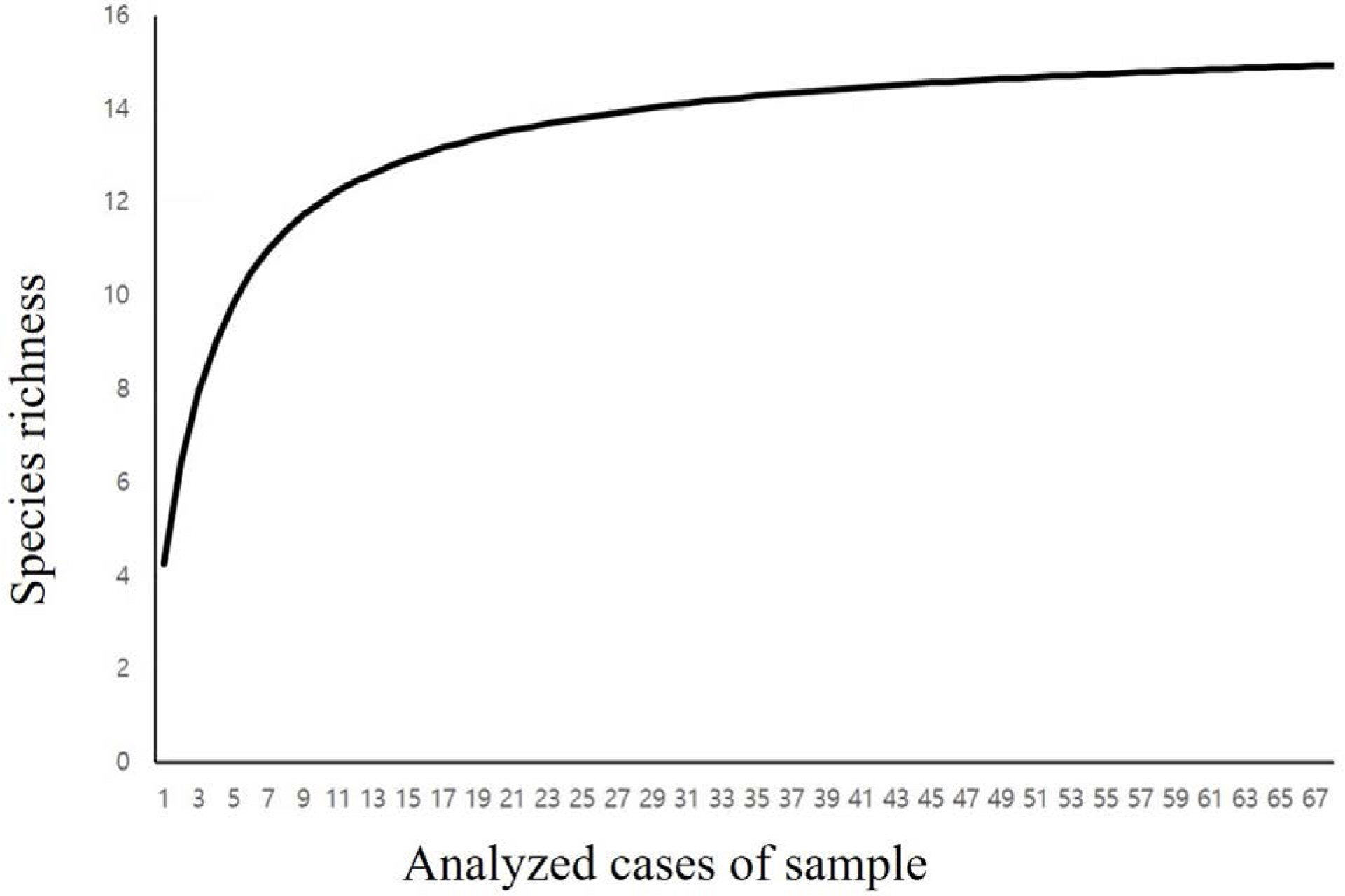
We found that the species accumulation curve generated in this study approached the asymptote (Fig. 1), thereby indicating that the sampling of carrion beetle had almost reached saturation for the species of cadaver fauna. We also established that the species richness of carrion beetles did not differ significantly among the three seasons assessed (Kruskal-Wallis test, P>0.05) or among the regions surveyed (Kruskal-Wallis test, P>0.05). Consistently, SIMPROF analysis indicated there were no significant differences among regions with respect to the composition of carrion beetle species (SIMPROF, P>0.05).
Furthermore, we found that N. (Calosilpha) brunneicollis brunneicollis, Ne. littoralis, and Ne. nigricornis were more frequently attracted (>40%) to the animal cadavers than other species (Fig. 2), whereas N. quadraticollis and N. tenuipes were observed only once on a pig cadaver at Okcheon.

A key to the Korean Silphidae of potential forensic importance
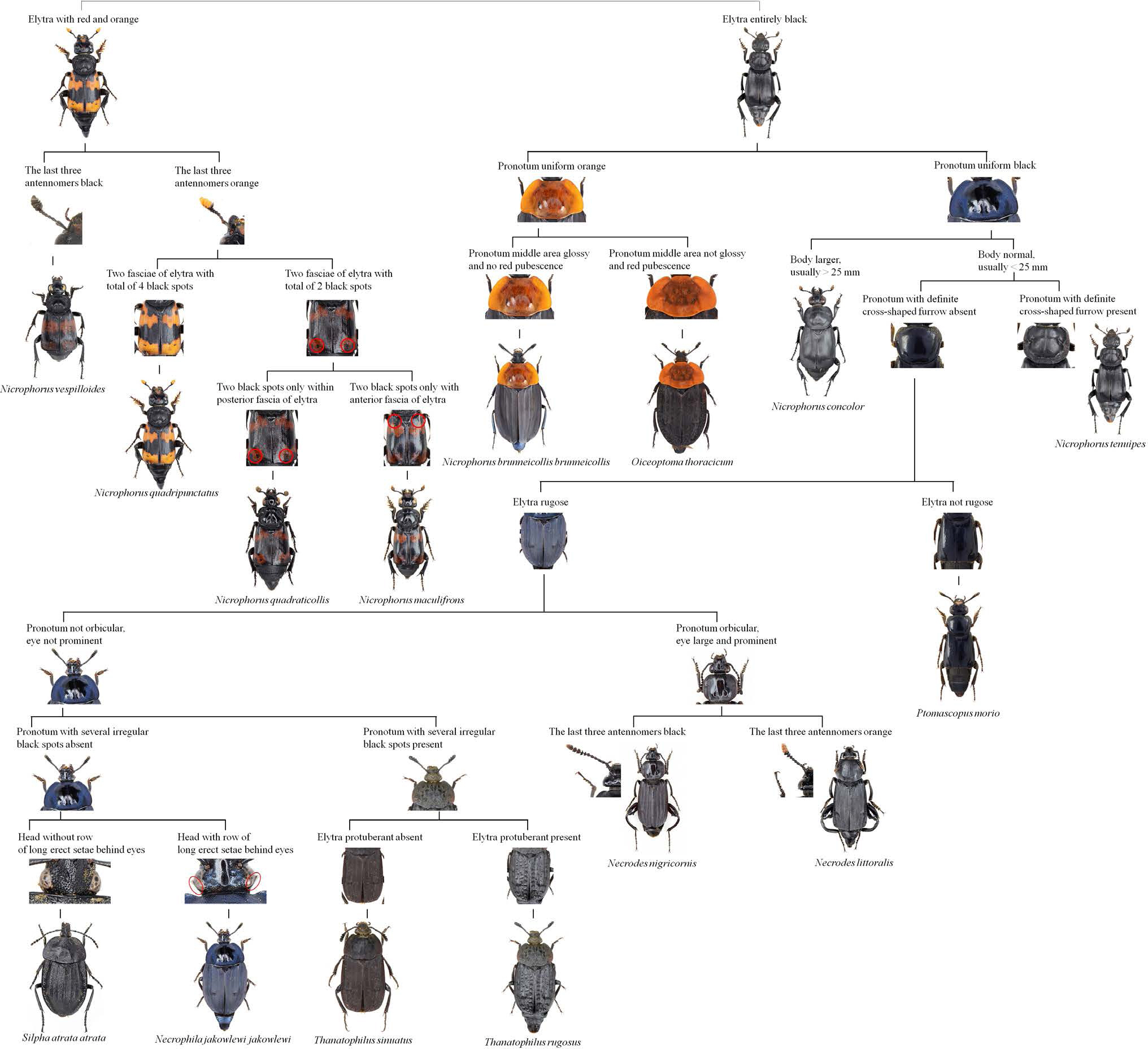
With the aim of assisting criminal and forensic investigators who wish to perform the rapid identification of cadaver-associated beetles and thereby potentially discover clues of forensic relevance, we prepared a relatively simple identification key to the important Korean fauna (Fig. 3). The concept and diagnostic combination of taxonomic characters were based on previous keys proposed by Cho [13] and Dekeirsschieter et al. [15], the user-friendliness of which was evaluated by conducting trail sessions with different groups of taxonomic novices.
Discussion
Although generally associated with decomposition, not all carrion beetles are considered to be of forensic relevance, and the findings of the present study and observations reported in the literature would appear to indicate that only 15 of the 26 species recorded in Korea are typically associated with cadavers.
On the basis of our observations indicating that species in the subfamily Silphinae are more frequently attracted to animal cadavers than are those in the subfamily Nicrophorinae (as shown in Fig. 2), we believe that silphinid species may be worth studying with regards to their potential utility as forensic bioindicators [10,33]. Indeed, these beetles typically deposit and abandon their eggs in or on soil in the vicinity of larger carcasses (>300 g), whereas Nicrophorus species in the Nicrophorinae tend to bury eggs within subterranean nests near smaller carcasses (generally <100 g), in which they guard their egg and exhibit biparental care throughout larval development [4]. P. morio is also known to be a brood parasite of Nicrophorus beetles [26].
Carrion beetles generally have a longer life cycle than dipteran species [11,12], and can also colonize corpses during the latter stages of decay when maggots have departed to pupate [12,34,35]. Therefore, the use of carrion beetles as bioindicators may be of potentially greater value from the perspective of forensic practice. However, given the general lack of interest in the Silphidae in forensic science, there has to date been no user-friendly key available for the purpose of identifying carrion beetles that occur on cadavers. To rectify this deficiency, we sought to prepare a reliable pictorial key that can be used to identify those species found on human and animal corpses.
We believe that this key will prove useful to those inexperienced in Silphidae taxonomy, as the characters upon which the key is based are generally external morphological features that are readily visible to the naked eye. Although relatively simple, we anticipate that this type of pictorial key would assist criminal investigators as taxonomic novices, thereby highlighting its importance [23]. This is particularly so, given that there are generally few local experts available to advise on matters relating to entomological identification, and that a correct identification of species and a reasonable understanding of their behavior is crucial for successful forensic interpretation.


 PDF Links
 PubReader
 ePub Link
 XML Download
 Full text via DOI
 Download Citation